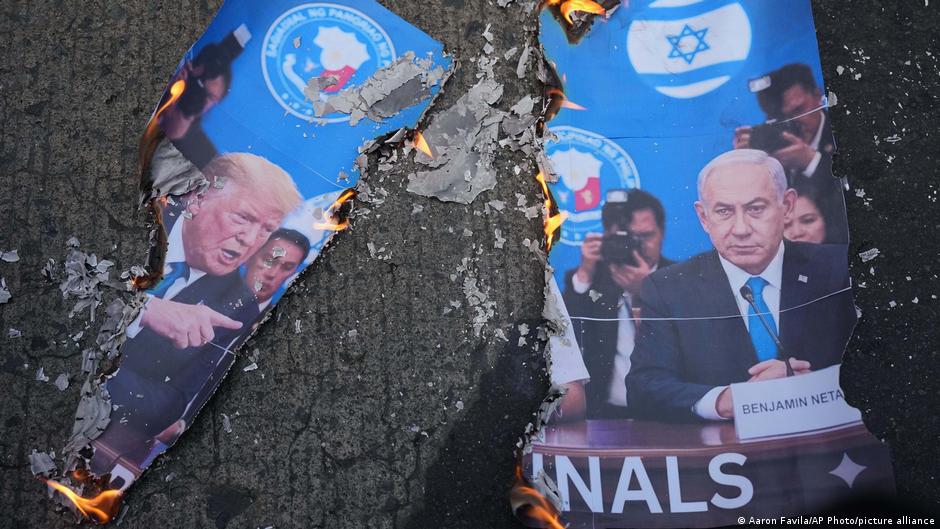
The conclusion drawn by the human rights organization Amnesty International in its report on last year is bleak: human rights violations are on the rise worldwide, at the hands of both states and non-state actors. And in the majority of cases, those responsible go unpunished. The "Amnesty Report 2025," which was just released in various locations worldwide, states that the year 2025 was marked by many powerful people acting like "predators." Amnesty specifically denounces political leaders whose actions dominated headlines worldwide last year: "Political leaders like Trump, Putin and Netanyahu, among many others, carried out their conquests for economic and political domination through destruction, suppression and violence on a massive scale."German president: Iran war violates international lawTo view this video please enable JavaScript, and consider upgrading to a web browser that supports HTML5 video 'Violating international law will not free Iran' According to Julia Duchrow, Secretary General of Amnesty International in Germany, the war in Iran is currently the most pressing issue. She emphasizes, however, that Amnesty has documented human rights violations in some 140 countries. In an interview with DW, Duchrow says: "In Iran, people face a double threat: first, from the attacks by the US and Israel in violation of international law — including against the civilian population and infrastructure — and second, from repression by their own government, which has already led to many thousands of deaths."And yet, according to Duchrow, the regime in Tehran can only be replaced if international law is also respected: "The unlawful attacks have not led to an improvement in the situation. We now fear even more intense attacks by the Iranian leadership against its own people." But it is not only the US, Russia and Israel that have long since abandoned the old world order. Many other states are also increasingly moving away from a system of politics based on firm international rules, according to Amnesty's annual report: "A world order that emerged from the ashes of the Holocaust and the unspeakable destruction wrought by two world wars, and which had been steadily built up over the past 80 years — with great effort, though unfortunately not sufficiently stable." And the nations that remain committed to democracy, the rule of law and international stability often seem helpless and increasingly reliant on appeasement.UN probe finds Israel committed acts of genocide in GazaTo view this video please enable JavaScript, and consider upgrading to a web browser that supports HTML5 video Is there really nothing left of the old world? Quite the contrary, according to Amnesty. The report praises the "masterful work" of diplomats and activists who have been striving for a more peaceful world since 1945: "The 1948 adoptions of the Universal Declaration of Human Rights and the Genocide Convention, and the many other normative instruments debated and adopted over the subsequent 80 years, are no illusion." The report says that those who are now loudly lamenting the end of the rules-based world are, for the most part, only interested in its demise: "Make no mistake: reports of the death of the international rule-based order are greatly exaggerated." Amnesty International singles out two governments in particular: those of the United States and Israel. With regard to the United States under President Donald Trump, the report states that in January 2026, Secretary of State Marco Rubio outlined a vision for a new order — a Western alliance of Christian civilizations — that simply ignored important historical facts. And the report does not mince words: "The words cannot hide the facts: this is a history too of domination, colonialism, slavery and genocide." The remarks on Israel's actions against its neighboring states in the Middle East conflict are also stark: "For millions of people, international safeguards have failed, as in the case of Palestinians who are subjected to genocide, apartheid and occupation by the Israeli government." And addressing Russian President Vladimir Putin, the report states: "Russia continues to commit crimes against humanity in Ukraine."Why prosecuting Russian war crimes in Ukraine is difficultTo view this video please enable JavaScript, and consider upgrading to a web browser that supports HTML5 video Hope for the engagement of civil society All of this points to a trend that seems likely to continue unabated and spawn new conflicts. However, at least in the case of the war waged by the US and Israel against Iran, the annual report notes that some EU member states clearly distanced themselves from the conflict: "In early 2026, some European states appeared to take fuller measure of the risks, refusing to join the US and Israeli attacks on Iran and committing to protect strategic security." And Julia Duchrow, too, still finds enough examples to give us hope in a world that seems to be falling apart: "In Iran, people took to the streets even though they knew their lives were in danger. In Hungary, Viktor Orbán's inhumane policies have just been voted out of office. And people continue to be released from detention, such as Maria Kolesnikova in Belarus, for whom we have advocated." Maria Kolesnikova, a well-known Belarusian musician and civil rights activist, was finally released from detention in December 2025 after five years. This article was originally written in German.
BreakingWars & Conflicts
Amnesty International paints a grim picture
Deutsche Welle April 20, 2026 at 11:04 PM
Original source
Deutsche Welle


