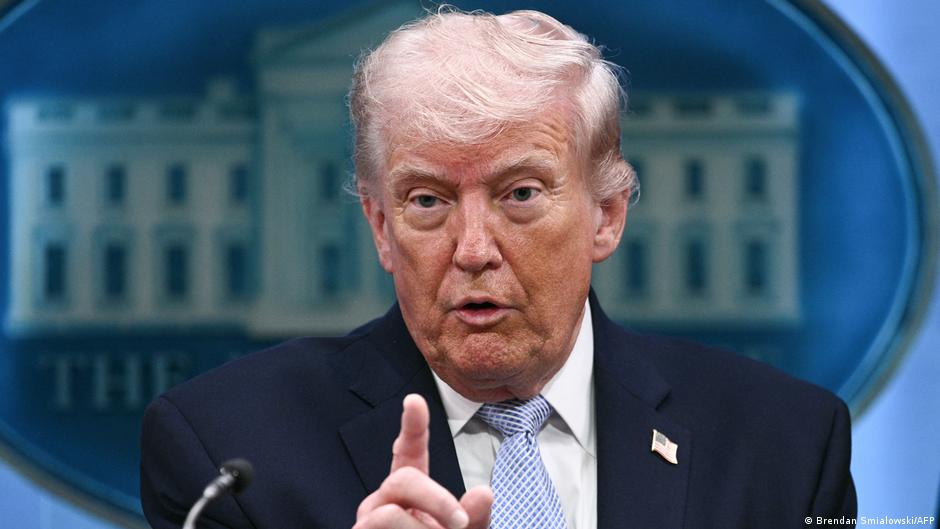
Iran's nuclear program has been at the heart of tensions between the US and the Islamic Republic for more than two decades. Washington has said Tehran is working toward developing nuclear weapons, something it wants to prevent at all costs. Iran has denied seeking the bomb, but insists on its right to a civilian nuclear program. US President Donald Trump has said stopping Iran from acquiring a nuclear weapon was a key reason behind the US decision to, together with Israel attack Iran on February 28. A ceasefire is now in place, and negotiations between the two sides could soon resume. Back to 2015? More than 10 years ago, Washington and Tehran reached a landmark compromise. The 2015 nuclear agreement, officially known as the Joint Comprehensive Plan of Action (JCPOA), was designed to curb Iran's nuclear program in exchange for sanctions relief. It collapsed after the US withdrew in 2018. Trump, who pulled the US out of the deal during his first term, has repeatedly argued that he could secure a "better" agreement than the one negotiated under President Barack Obama. The question is whether a new deal can realistically go further — or whether diplomacy today is operating under far worse conditions than in 2015. What did the 2015 nuclear deal achieve? After 20 months of negotiations, Iran and the US reached an agreement in July 2015, together with Russia, China and the European Union, led by France, Germany and the United Kingdom, then still a member state. The deal significantly slowed Iran's ability to produce enough fissile material for a nuclear weapon, known as its "breakout time," from about two to three months to roughly a year. The JCPOA also gave the UN's nuclear watchdog, the International Atomic Energy Agency (IAEA), broad access to inspect Iran's nuclear facilities. In return, international economic sanctions on Iran were lifted. The deal came into force in January 2016 after the IAEA confirmed Iran was complying. Iran and world powers negotiated the nuclear deal in Vienna in 2015, which later became known as the JCPOAImage: United States Department of State "The IAEA did get unprecedented access," said Oliver Meier, an expert on nuclear disarmament at the European Leadership Network. "It limited the number of centrifuges and the types of centrifuges Iran was using, and it reduced the stockpiles of fissile material inside Iran." Centrifuges enrich uranium by spinning uranium gas at high speed. However, Meier added, "all of this was time‑bound. Some restrictions were supposed to expire after 10 or 15 years, assuming that international confidence would have been rebuilt by then." What the deal did not cover The JCPOA also had clear limits. It did not restrict Iran's ballistic missile program, nor did it address Tehran's role in regional conflicts, including its support for groups such as Hezbollah in Lebanon. "There was a conscious decision at the time to leave out certain aspects that, in hindsight, might have been better tackled," said Meier. "There was hope in 2015 that once the nuclear issue was resolved, it would be easier to deal with regional security. That may have been a mistake." These gaps fueled criticism in the US. Opponents argued the deal postponed rather than eliminated the nuclear threat and failed to curb Iran's broader strategic ambitions. When Trump first came to power in January 2017, he called the JCPOA "the worst deal ever negotiated" and withdrew the US a year later. His administration reimposed sweeping sanctions, arguing that economic pressure would force Iran to accept a broader and tougher agreement.From failed diplomacy to war Iran initially stayed within the deal, hoping the remaining signatories could offset US sanctions. Over time, however, Tehran began to scale back its commitments. It enriched uranium to higher levels, installed more advanced centrifuges and reduced cooperation with inspectors. "The outcome was unfortunately that Iran's breakout time was considerably shortened," said Meier. By 2024, the IAEA estimated that time had fallen to weeks or even days, although there was no clear evidence that Iran had decided to build a nuclear bomb. In early March, Iran’s Natanz nuclear facility was damaged after airstrikesImage: Satellite image ©2026 Vantor/AFP Efforts to revive or replace the nuclear deal continued for years, culminating in renewed negotiations in 2025 and 2026. Those talks collapsed when the US, together with Israel, launched strikes on Iran on February 28, triggering Iranian counterattacks on Israel and US allies in the Gulf. After 40 days of fighting, the US and Iran agreed to a ceasefire on April 8. It is against this backdrop that talks between the two sides are now set to resume in Islamabad. What's on the table now The main dispute right now is over time. The US is demanding a 20‑year suspension of Iran's nuclear activities, while Iran has said it is only willing to accept restrictions for up to five years. Other key questions remain unresolved. Who would monitor Iran's nuclear facilities? What would happen to its stockpile of enriched uranium? And how many centrifuges would Iran be allowed to keep? Has the Iran war harmed nuclear non-proliferation efforts?To view this video please enable JavaScript, and consider upgrading to a web browser that supports HTML5 video "The issues that need to be resolved now are, not surprisingly, the same ones the 2015 deal addressed," said Meier. "That agreement ran to about 150 pages with detailed annexes." That is why Meier is skeptical that a solution can be found within days, or even weeks. Why talks are harder this time Many experts believe JCPOA was possible because a basic level of trust still existed between the parties. Today, that foundation has largely disappeared. Alan Eyre, who was part of the US negotiating team in 2015 and is now at the Middle East Institute, said both sides have hardened their positions. "There's a tremendous amount of distrust and suspicion on the American side towards Iran and on the Iranian side toward the United States," he told DW. Eyre also said Iran has regained strategic leverage. Despite suffering heavy losses in the war, Tehran still has the ability to retaliate with missiles, rockets and drones. It can also threaten shipping through the Strait of Hormuz and rely on regional proxy forces such as Hezbollah or the Houthis— leverage it did not have in 2015. Eyre said the current US administration had a demonstrated lack of expertise when it comes to diplomacy, which takes time and sustained effort. "They're really not used to doing that. They're used to telling countries what to do and countries doing it. So, it's an open question of whether JD Vance will be able to negotiate successfully with the Iranians, who are experienced and skilled negotiators," he said. Former negotiators say experience and trust matter as much as leverage. So, can Trump still get a better deal than Obama? In one sense, experts say the answer could be yes. "It will be easier to get a better deal in the sense that many nuclear facilities have been destroyed," said Meier. "Iran may be more willing to accept that some of these sites are no longer on the table." Politically, however, the situation is far more complicated than it was a decade ago. "We are in a much worse place than in 2015," said Meier. "The attacks have not solved the problem. They have made it worse, because more people in Iran now believe a nuclear weapon is needed to deter future US attacks." That has made long‑term limits harder to achieve. As Washington and Tehran consider another attempt at diplomacy, the question is no longer just whether a better deal is possible — but whether the conditions that made the 2015 agreement work can be recreated at all. Edited by: Don Mac Coitir
BreakingWars & Conflicts
Can Trump get a better Iran deal than Obama?
Deutsche Welle April 15, 2026 at 05:46 PM
Original source
Deutsche Welle