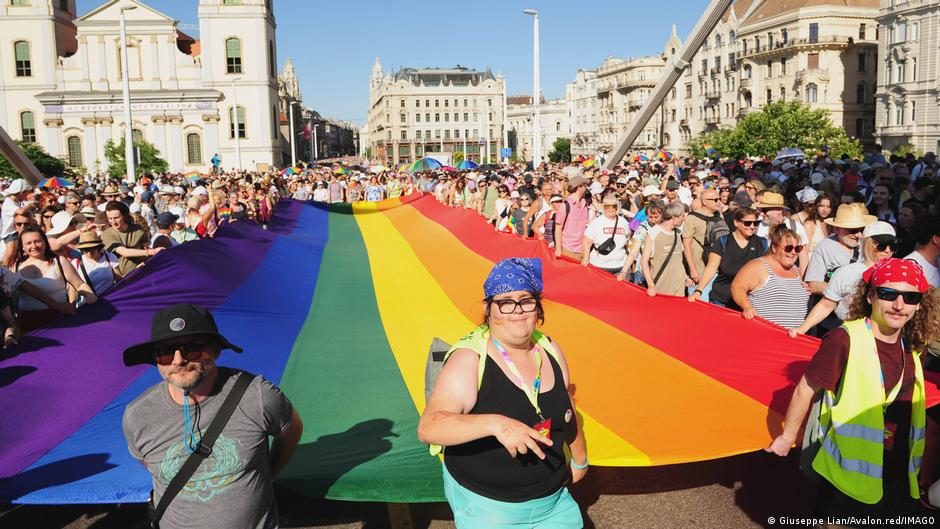
The European Court of Justice (ECJ) on Tuesday ruled that Hungarian LGBTQ+ laws introduced in 2021 violated EU laws and values on multiple levels. The contentious reforms — dubbed "the amending law" in Hungary and introduced under outgoing Prime Minister Viktor Orban and his Fidesz party — sought to limit children's access to information about transgender and homosexual issues and to ease public access to the criminal records of sex offenders, among other changes. Tuesday's ECJ judgment will put pressure on Hungary's incoming government led by Peter Magyar, who won a landslide in elections against longstanding PM Orban earlier this month, to alter or abolish the laws "without delay" or face sanctions from Brussels. Which laws did the ECJ deem to be broken? The court sided with all the complaints the European Commission had lodged against the law. This amounted to a breach or breaches of a series of fundamental laws or principles: EU laws guaranteeing the freedom to provide or receive services, in this case information or promotion pertaining to homosexuality or gender deviation Protections of several fundamental rights, including the prohibiton of discrimination based on sex or sexual orientation, respect for private and family life, and freedom of expression The right to human dignity enshrined in Article 2 of the Treaty of the European Union — a principle the court had not previously found a member state to have violated Data protection standards enshrined in the EU's General Data Protection Regulation (GDPR), in this case by making criminal records of sex offenders publicly available in a way the court deemed too imprecise and poorly restricted How much Orban influence remains in Hungary's politics?To view this video please enable JavaScript, and consider upgrading to a web browser that supports HTML5 video Why did the ECJ deem the law breached free provision and reception of services? Hungary had justified the new laws in large part on the basis of protecting children. The ECJ found that member states did have a degree of autonomy, "in the absence of harmonising rules at EU level," in deciding what content, including audiovisual material, was liable "to impair the physical, mental or moral development of minors." It also said the countries do have some scope "to safeguard the right of parents to ensure the education and teaching of their children in conformity with their religious, philosophical and pedagogical convictions." However, the court also found that these rights needed to achieve a balance "with the prohibition on discrimination based on sex or sexual orientation" guaranteed by Article 21 of the EU's charter of fundamental rights. It said that the discriminatory aspect of the law was the criterion that any "portrayal or promotion of deviation from the self-identity corresponding to the sex assigned at birth, of gender reassignment, or of homosexuality ... whatever its specific content, is such as to be detrimental to the best interests of the child." The ECJ said that this approach "reveals a preference for certain identities and sexual orientations to the detriment of others, which are stigmatized as a result, which is incompatible with the requirements flowing, in a society in which pluralism prevails, from the prohibition on discrimination based on sex or sexual orientation." Budapest Pride Parade set to draw record numbers despite banTo view this video please enable JavaScript, and consider upgrading to a web browser that supports HTML5 video Why did the ECJ deem the law breached fundamental rights and respect to human dignity? The court found that the law was not compatible with the ban on discriminating against people based on their sex or sexual identity. "In particular, the Hungarian legislation at issue stigmatises and marginalises non-cisgender persons – including transgender persons – or non-heterosexual persons as being detrimental to the physical, mental and moral development of minors solely on the basis of their gender identity or sexual orientation," the court said. It also argued that the title of the legislation "associates those persons with persons convicted of pedophilia," a connection it said was designed "to increase the stigmatisation of the former and to encourage hateful conduct towards them." It found the law to violate guarantees to protect human dignity by treating a group of people as a threat to society "solely on the basis of their gender identity or sexual orientation." By establishing, maintaining or reinforcing their social "invisibility," the court said, the law breached their right to human dignity. It's the first time the court has found a member state to be in breach of Article 2 of the Treaty of the European Union, which guarantees "values of respect for human dignity, freedom, democracy, equality, the rule of law and respect for human rights, including the rights of persons belonging to minorities." "Hungary cannot validly rely on its national identity as justification for adopting a law which is in breach of the values referred to above," the court argued. Hungary is in the midst of a change of government after Peter Magyar's election win, although Magyar has not generally sought to strike a vastly different stance on social issues compared to the positions held by the Fidesz party of which he was once a memberImage: Robert Nemeti/Anadolu Agency/IMAGO Why did the ECJ deem the law breached data protection standards? Lastly, the ECJ found that the rules on making sex offenders' personal information publicly available did not conform with the General Data Protection Regulation (GDPR). "Although such access may be lawful in certain circumstances, the Court finds, in essence, that the Hungarian legislation does not provide a sufficiently precise definition either of the persons authorized to access criminal records data or of the substantive conditions for access necessary to offer appropriate safeguards for the rights and freedoms of the persons whose data are concerned," the ECJ said. Noncompliance with ECJ rulings of this nature, typically involving either the revocation or alteration of the laws to the court's satisfaction, can lead to financial penalties and other sanctions. Edited by: Natalie Muller
BreakingWars & Conflicts
Hungary: Orban-era LGBTQ law infringes human rights, ECJ rules
Deutsche Welle April 21, 2026 at 10:43 AM
Original source
Deutsche Welle