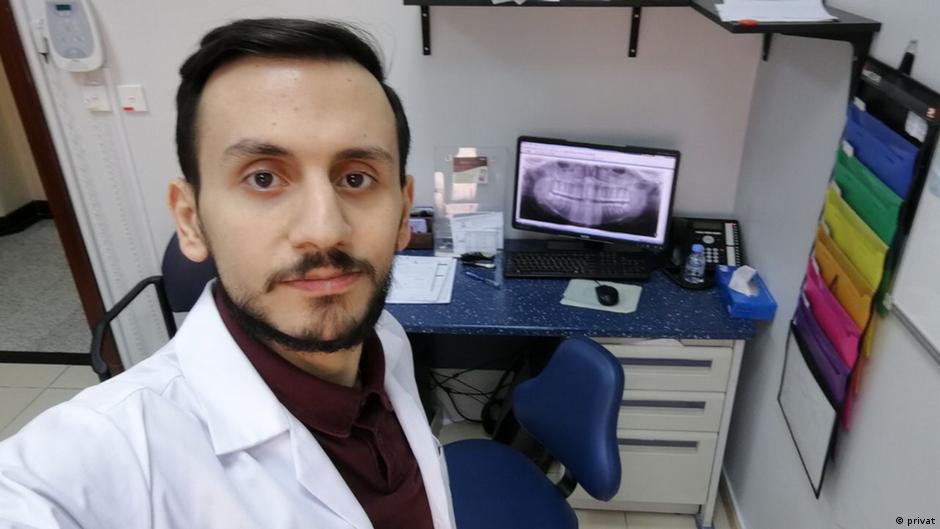
On March 20, only days before Friedrich Merz and interim Syrian President Ahmed al-Sharaa raised the issue of repatriating hundreds of thousands of Syrians, Basel Gawish received a letter from the Federal Office for Migration and Refugees (BAMF). It was the letter that the 31-year-old Syrian had always feared: It stated that his asylum application had been rejected, that he was not eligible for subsidiary protection status and that he had to leave Germany within 30 days. "I was completely shocked and devastated," Gawish told DW. "I was kidnapped in Syria and fled through several countries. I would never have imagined that my asylum application would be rejected." His last hope was to file an appeal with the Federal Constitutional Court in Karlsruhe, Germany's equivalent of the US Supreme Court. After just two years in Germany, Gawish speaks near-perfect German. He is a licensed dentist currently working in the small southern town of Bühl as a trainee for an oral surgeon who hopes to hire him after his internship. He also volunteers as a translator for several charities, including the German Red Cross, and even the federal police — in Arabic, English and Turkish. "This is my country. I speak the language," he said. "I want to stay. Two years ago, Germany gave me a roof over my head and supported me. I have great respect for that and want to give something back to the country." Merz says 80% of Syrians in Germany will returnTo view this video please enable JavaScript, and consider upgrading to a web browser that supports HTML5 video 'Grannies Against the Right' protest Gawish's deportation Gawish has the backing of a group called "Grannies Against the Right," a citizens' initiative that has collected nearly 30,000 signatures for its "Basel Must Stay!" petition to stop his deportation. Nadja Glatt, who launched the petition, told DW that the goal is to double that number. "There is a shortage of dental professionals in Germany," she said. "It makes no sense to deport people like this. It's completely crazy and just reckless. From the very beginning, Basel Gawish has done everything he can to integrate into German society. His only wish is to settle here and be allowed to work as a dentist or oral surgeon."German government wants more Syrians to return Does this mean that Gawish is one of the 80% of Syrians that Germany wants to see return to Syria over the next three years? That figure was mentioned in a press conference that Merz and al-Sharaa held at the end of March. Following significant criticism, both leaders have attempted to distance themselves from that figure — rather bizarrely, both have since said that the other brought up the goal during their meeting in Berlin. But one thing is clear: Germany's governing coalition of the conservative Christian Democratic Union (CDU)/Christian Social Union (CSU) and the center-left Social Democratic Party (SPD) aims to encourage a large number of the nearly 950,000 Syrians currently in Germany to return home. A recent proposal by the Hesse state Interior Minister Roman Poseck (CDU) — who even suggested repatriation by ship — aligns with this goal. "Deporting people who are well-integrated and easy to track down — for example, at their workplace — isn't necessarily what you'd want to do, but it's the easiest to implement," said Marie Walter-Franke of the German Council for Integration and Migration (SVR). "People who do everything right — who are registered, have a job and may even have children in school — naturally leave a large administrative paper trail behind them," she told DW. "We know where they live, where they go every day and so they're easy to get a hold of."A young Syrian woman in eastern GermanyTo view this video please enable JavaScript, and consider upgrading to a web browser that supports HTML5 video Skilled labor shortage: People come, but often don't stay Walter-Franke specializes in the naturalization and integration of refugees. As part of a research project, she has conducted interviews with dozens of Syrian refugees over the past few years, including those who only arrived after the fall of the Assad regime in 2024. Due to the unstable situation and the dire shortage of resources in Syria, no one wants to return, said Walter-Franke — quite the opposite, in fact. Merz, meanwhile, has insisted that a majority of Syrians would like to return and rebuild their homeland. The migration expert is highly critical of the latest debate on Syria. "What bothers me is the underlying message that essentially tells all foreigners, 'You are not welcome here.'" She acknowledges that Germany has made significant progress in terms of migration policies, including training programs for skilled workers abroad and initiatives to recruit individuals for study and employment. "But we have a major problem keeping people here long term," she said. "Statements that focus solely on repatriation and deportation don't make things any better." Young Syrians as a potential workforce Walter-Franke believes Germany needs more staff at immigration offices and courts, so Syrians do not have to wait long for residence permits and so can get into the workforce. She also supports the right of Syrians to visit their homeland without thereby jeopardizing their residence status in Germany. There should also be clearly defined opportunities for businesses and refugees, she says, so that it is possible to remain in the country and find employment after completing training, as was the case with Gawish and his oral surgeon. Most importantly, the government should recognize the great potential that Syrian immigration brings. "We must also not forget that one-third of Syrians currently living in Germany are minors enrolled in school," she said. "This amounts to over 200,000 people who will be ready to enter the labor market in the coming years. These individuals speak German fluently, have grown up here and will not face the same barriers as their parents when it comes to language, qualifications and recognition of those qualifications." This article was translated from German.
BreakingWars & Conflicts
Is this Syrian doctor one of the 80% Germany wants to remove?
Deutsche Welle April 11, 2026 at 01:46 PM
Original source
Deutsche Welle