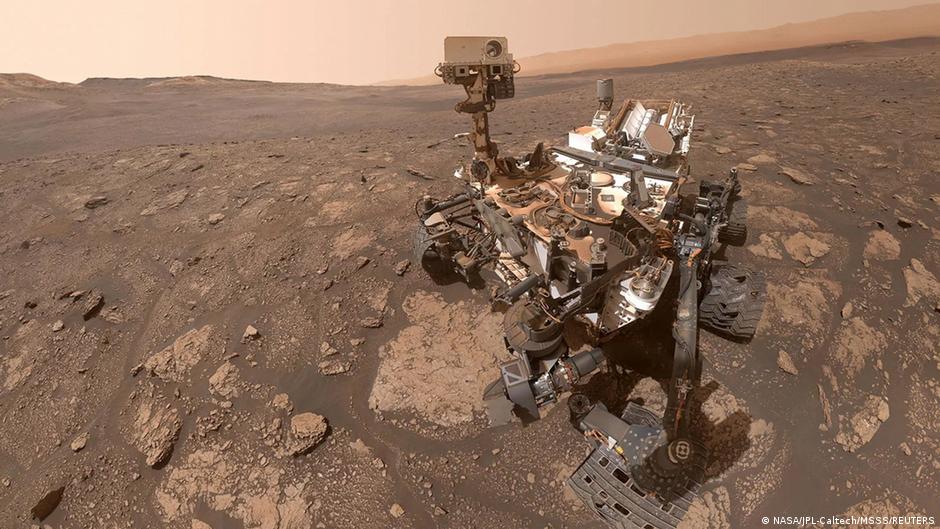
NASA's Curiosity Mars rover has identified seven organic compounds in rock near the planet's equator, five of which had not previously been found on Mars. Researchers publishing in the journal Nature Communications on Tuesday said the experiment also hinted at the presence of another organic compound bearing a structure similar to the precursors to DNA, the molecule that carries genetic information in living organisms on our planet. However the scientists also noted that the organic compounds — molecules primarily composed of carbon atoms bonded to other elements that form the structural basis of all life on Earth — could have formed through nonbiological processes. Further evidence that Mars may have been a habitable planet billions of years ago Like the Earth and other planets in the solar system, Mars is thought to have formed around 4.5 billion years ago. Early in its history it was warmer and wetter than the cold, dry place it is today. Both of NASA's Mars rovers, Curiosity and Perseverance, have identified organic materials on the planet. The Curiosity rover had been exploring the vast Gale Crater, thought both to be caused by an impact from a meterorite and to be a now-dry lake. The abundance of clay present in the Glen Torridon area of the crater suggests water was once present there. The meteorite could have brought organic matter to the planet and the water could have provided suitable conditions for it to develop. Curiosity's search focused on an area thought to have once contained water, fundamental to the formation of carbon-based life as we know itImage: NASA "We cannot yet say that Mars ever harbored life, but our findings further support the evidence that Mars was a habitable world around the time that life of Earth originated," said Amy Williams, an astrobiologist and planetary scientist at the University of Florida, member of the Curiosity scientific team, and lead author of the study. "To be clear, we have not found evidence for life with this study, but we're further refining the building-block molecules that were present on Mars," Williams said. Building blocks of life preserved in rocks for billions of years Researchers estimated that the rock samples analyzed dated to at least 3.5 billion years ago. Curiosity, which landed on Mars in 2012, took the samples in question in 2020. One molecule identified, benzothiophene, has also been found in meteorites and asteroids. "The same stuff that rained down on Mars from meteorites is what rained down on Earth, and it probably provided the building blocks for life as we know it," Williams said. "We're seeing the building blocks for life — prebiotic chemistry on Mars — preserved in these rocks for billions of years." In 2022, Curiosity identified high concentrations of carbon 12, another potenital indicator of life long ago, in the Gale CraterImage: NASA/ZUMA/picture alliance Clay can preserve such organic molecules better than other minerals, explaining why the site was chosen as a search point. The Curiosity rover was dispatched carrying a chemical called TMAH, which can break apart organic matter to see what it's made up of. Such a test had not been conducted off Earth before. Williams said that another molecule identified containing nitrogen "is a precursor to how DNA is eventually built." Williams said it was ultimately not possible to tell if the organic matter came from "geologic processes, infall from meteorites, or life," but said the findings did suggest that "if complex organic matter from life were preserved on Mars, we should be able to detect it with current and upcoming rover instruments." Was there life on Mars? New clues spark hopeTo view this video please enable JavaScript, and consider upgrading to a web browser that supports HTML5 video
BreakingWars & Conflicts
Mars: NASA's Curiosity rover finds new organic matter in Gale Crater
Deutsche Welle April 21, 2026 at 01:55 PM
Original source
Deutsche Welle


