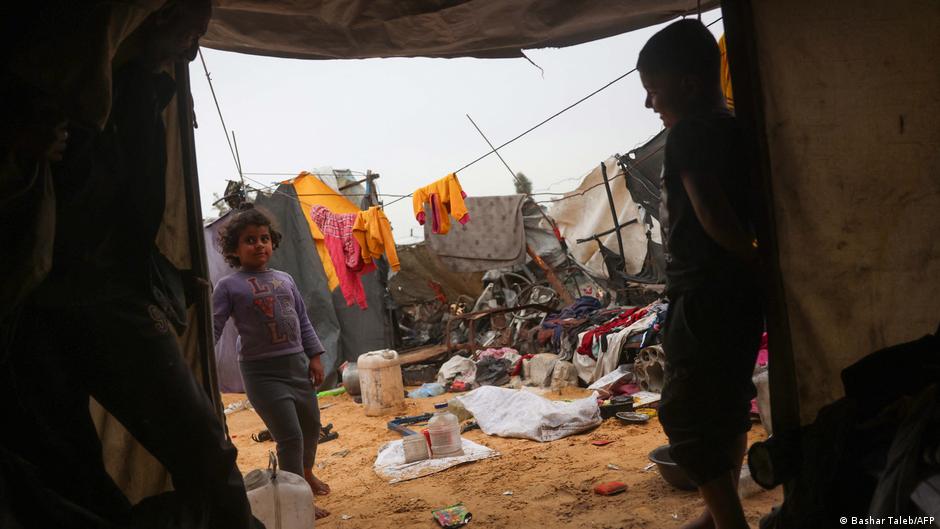
Efforts to broker a stable ceasefire in the Gaza Strip between Hamas and Israel have been underway for many months, with very little progress. Last Sunday, a Hamas delegation set off for Cairo to discuss the next steps in the ceasefire process with Egyptian mediators. The focus still remains on unresolved issues from the first phase of the ceasefire, agreed upon over half a year ago. Another key question is whether a second, and above all, final phase is even achievable. Hamas, a militant Islamist group classified as a terrorist organization by Germany, the European Union, the US and other countries, triggered the devastating war in Gaza with its attacks on Israel on October 7, 2023. A fragile ceasefire has been in effect since October 10, 2025, but it has repeatedly been undermined by isolated attacks. "Six months into the ceasefire, civilians in Gaza remain trapped amid attacks on civilians, restricted aid and an uncertain political process that is now shaping whether recovery will begin or collapse," the Norwegian Refugee Council said on April 10.The humanitarian situation for civilians in Gaza remains dire, and much of the promised funding has yet to arriveImage: Dawoud Abu Alkas/REUTERS Negotiations without progress The work of the Board of Peace, launched with grand political ambitions by US President Donald Trump in January, has so far had little impact. While institutional structures have been established and billions in funding have been promised, much of this money has yet to arrive, according to media reports. "At the moment, everything seems to be going round and round in circles," Peter Lintl, Israel and Middle East observer at the German Institute for International and Security Affairs (SWP) in Berlin, told DW. The key issues — the disarmament of Hamas, the future administration of Gaza and the withdrawal of Israeli troops — still remain unresolved. "At the same time, there is a lack of functioning mechanisms to enforce any agreements — should they be reached," said Lintl. Simon Wolfgang Fuchs, associate professor of Islamic and Middle Eastern studies at the Hebrew University of Jerusalem, takes a similar view. "The talks are not making progress, and deadlines have repeatedly passed," he said. In his view, a diplomatic stalemate is solidifying, "characterized more by mistrust than by rapprochement." Board of Peace 'nonstarter': former UN envoy Volker PerthesTo view this video please enable JavaScript, and consider upgrading to a web browser that supports HTML5 video Sticking point: Disarming Hamas The difficulty lies not only in the details, but in fundamental questions. For instance, the parties to the conflict continue to disagree on whether Hamas must be disarmed first — or whether Israel must first withdraw its forces. In late January, US Ambassador to the United Nations Mike Waltz said "independent international monitors will supervise a process of demilitarization of Gaza." While these plans suggest there are some specific ideas for a transition, such a proposal requires both sides to make fundamental concessions. "For Israel, the order is clear: disarmament first, then withdrawal. Whereas for Hamas, it is exactly the opposite," said Fuchs, describing the dilemma. Both sides remain entrenched in positions that are almost impossible to reconcile, he added. Yet the entire course of future developments hinges on reaching an agreement. At the same time, Hamas continues to control parts of Gaza and effectively acts as the ruling authority and law enforcement despite two years of Israel's brutal offensive, which involved targeted killings of Hamas officials and killed around 72,000 Palestinians.Humanitarian situation in a 'downward spiral' Meanwhile, the humanitarian situation in Gaza remains precarious, and in many places it has even deteriorated further. Civilians continue to bear the brunt of supply shortages, rising prices and damaged infrastructure. "The situation is a downward spiral," Fuchs told DW. Even when aid deliveries arrive, uncertainty remains high, he added. "Experiences from previous shortages and, above all, the famine of 2025 continue to have an impact here and reinforce the feeling of constant threat." At the same time, the political mood in Gaza is difficult to assess from the outside. "Reports suggest that any criticism of Hamas in its territories tend to be brutally suppressed," said Lintl. Moreover, Palestinians in Gaza are concerned about their permanent displacement by Israel. For Palestinians in Gaza, a lasting solution remains out of sight ongoing talks and a ceasefireImage: Eyad Baba/AFP Tense military situation The situation has been further exacerbated by recent Israeli attacks on Hamas leaders, with civilians repeatedly caught in the crossfire. An analysis published by the international aid organization Oxfam on April 10 came to the conclusion that Trump's ceasefire plan is on the verge of failure. Other central elements of the Gaza plan have not yet been implemented, and the planned technocratic body for the enclave's civilian administration is still not in place. Funding for reconstruction remains uncertain, and prospects are not good due to the tense situation in the entire region. The Gulf states, which had pledged to cover a large portion of the reconstruction costs in Gaza, are themselves under pressure due to the devastation caused by the war in Iran. "Refineries, fields and export terminals damaged by missile and drone strikes will require months, and in some cases years, to repair," columnist Ron Bousso wrote for the Reuters news agency on April 8. Funds for Gaza are likely to be correspondingly scarce, he predicted. "I am skeptical that a breakthrough will be achieved in the short term," said Lintl, pointing out that many structural obstacles remain and that the political stakes are too high on both sides. Many international analysts share this view. While a ceasefire is in place and is making daily life somewhat easier for people, a viable political solution is still nowhere in sight. And renewed escalation remains, in principle, possible at any time. Gaza's future: From rubble to riches?To view this video please enable JavaScript, and consider upgrading to a web browser that supports HTML5 video This article was originally written in German.
BreakingWars & Conflicts
Overshadowed by Iran, Gaza stuck between war and peace
Deutsche Welle April 17, 2026 at 08:44 AM
Original source
Deutsche Welle