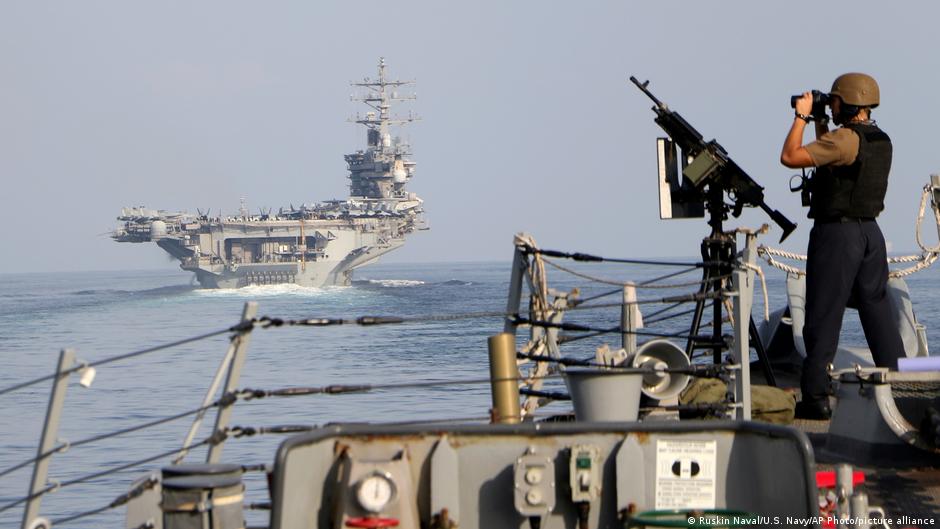
How will Trump's blockade of Iranian oil work? After US-Iran peace talks in Pakistan collapsed at the weekend, US President Donald Trump said the US Navy would block ships entering or leaving any Iranian port or coastal facility via the Strait of Hormuz. Until the war began in late February, a fifth of the world's seaborne oil trade passed Hormuz, the narrow stretch of water between the Persian Gulf and the Indian Ocean. If successful, the blockade would sever Iran's main source of revenue by halting its nearly 2 million barrel-per-day oil export trade, which Trump is betting will force Tehran back to the negotiating table. US officials said the goal was to strip Iran of leverage gained from its control of the waterway, which Tehran effectively shut when the war began, stranding hundreds of oil and gas tankers. Trump also framed the blockade as preventing Tehran from charging up to $2 million (€1.71 million) per vessel for safe passage through the strait, according to reports. US warships test Hormuz passage as mine risks loomTo view this video please enable JavaScript, and consider upgrading to a web browser that supports HTML5 video"No one who pays an illegal toll will have safe passage on the high seas," Trump wrote on Truth Social on Sunday, adding that the US Navy would also "begin destroying the mines the Iranians laid" in the strait. The US Central Command (CENTCOM), which directs Washington's military forces, said the blockade would not affect vessels traveling to and from non-Iranian ports — like Saudi Arabia, Qatar and the United Arab Emirates. How will the US Navy enforce the blockade? The operation, which was due to begin on Monday, was announced with a notice to mariners. CENTCOM said the blockade would be "enforced in the Gulf of Oman and Arabian Sea east of the Strait of Hormuz" and would include "the entirety of the Iranian coastline ... not limited to ports and oil terminals." The advisory continued: "Any vessel entering or departing the blockaded area without authorization is subject to interception, diversion and capture." Maritime law experts said enforcement would rely on standard naval procedures known as the right of visit and search, where US warships stop and inspect tankers and can divert them if they are suspected of carrying Iranian oil. While the use of visit and search has precedent in naval warfare, several experts warned the blockade risked crossing into disputed territory under maritime law, affecting neutral ships and a long-term disruption of a critical international strait. Within hours of Trump's announcement, the trickle of tanker traffic in the strait halted again, according to Lloyd's List Intelligence, a maritime‑data company.How quickly could the blockade hit Iran's oil exports? A US blockade could sharply curtail Iran's ability to load and ship crude from its main export terminal, Kharg Island in the Persian Gulf, which handles more than 90% of the country's oil shipments. Almost all of Iran's oil exports go through one terminal at Kharg Island located in the Persian GulfImage: Fatemeh Bahrami/Anadolu Agency/IMAGOIran continues to export oil despite international sanctions tied to its nuclear program, relying on a shadow fleet of aging tankers, employing ship-to-ship transfers off Malaysia and other evasion tactics. The US had also given Iran temporary permission to sells its oil as a measure to help stabilize markets during the ongoing conflict. The new naval blockade is set to make those loadings far riskier and less likely, as operators face the prospect of boarding, diversion or seizure. Iran’s internet shutdown draws condemnation from abroadTo view this video please enable JavaScript, and consider upgrading to a web browser that supports HTML5 videoLast year, Iran's oil exports totaled around $45 billion, or 13% of GDP, according to London-based Capital Economics. With no land pipelines to divert crude supplies, Iran has few other non-sea export options. Even its Jask export terminal on the Gulf of Oman could still be searched by the US Navy. Sustained US pressure could force Tehran to quickly return to the negotiating table as it loses this revenue. Could the blockade lead to a wider conflict? Trump's blockade threat was met with threats of retaliation by Iran's Revolutionary Guard Corps. It declared that if Iranian ports faced restrictions, "no port in the Gulf and the Sea of Oman will be safe," raising fears of strikes on energy or shipping infrastructure in Gulf neighbors. Ebrahim Rezaei, a spokesperson for the Iranian parliament's National Security Commission, also warned that Tehran was prepared to respond militarily if necessary. "It will make the current situation [Trump] is in more complicated and makes the market — which he is angry about — more turbulent," wrote Rezaei on X. "And we may also reveal other cards that we have not used in the game." Several US experts have questioned Trump's move, saying he may be drawing the US into an open-ended military commitment. "Trump wants a quick fix. The reality is, this mission is difficult to execute alone and likely unsustainable over the medium to long-term," Dana Stroul, a former senior Pentagon official during the Biden administration, told Reuters news agency. Neil Shearing, group chief economist at Capital Economics, wrote that the blockade "may also be designed to pressure Beijing into playing a more active role in mediating a ceasefire and reopening full trade flows through the strait." Next to Iran, China stands to lose the most economically from a blockade, since it has bought up 80-90% of Iran's seaborne crude exports in recent years. Shearing also wondered whether the US Navy would seize allied ships that paid tolls to Tehran or Chinese vessels in the strait, saying either would represent a "significant escalation." Edited by: Tim Rooks
BreakingWars & Conflicts
US maritime restrictions increase economic pressure on Iran
Deutsche Welle April 13, 2026 at 04:31 PM
Original source
Deutsche Welle


